SCCL生涯教育コースおよび関連コンテンツに関する免責事項

サスカトゥーン・コロストラム・カンパニー・リミテッド(以下「SCCL」という。 「コース」)、 および関連するすべての情報資料およびコンテンツ、 を含むがこれに限定されない、 SCCLの電子ニュースレターおよび表示ページ(以下「関連コンテンツ」といいます。 は、「現状有姿」で提供されます、 は、「現状有姿」で提供され、一般消費者の理解と教育のみを目的としています。 のみを目的としています。本コースまたは関連コンテンツへのアクセスは任意であり、利用者の責任において行われるものとします。 SCCLは、いかなる種類の表明または保証も行いません、 を行うものではありません、 完全性 正確性 信頼性 SCCLは、本コースまたは関連コンテンツの完全性、正確性、信頼性、適合性、または利用可能性について、明示または黙示を問わず、いかなる保証も行いません。利用者が コースまたは関連コンテンツに不満がある場合、 利用者の唯一かつ排他的な救済手段は、本コースおよび本サイトの利用を中止することです。本コースまたは関連コンテンツに含まれる 本コースまたは関連コンテンツに含まれるいかなるものも、本コースまたは関連コンテンツに代わるものとみなされるべきではありません、 またはその代わりとして使用されるべきものではありません、 獣医学的アドバイス、 診断または治療に代わるものではありません。本ウェブサイトで提供される情報は、教育および情報提供のみを目的としたものであり、獣医師またはその他の専門家による専門的なアドバイスに代わるものではありません。 本サイトで提供される情報は、教育および情報提供のみを目的としたものであり、獣医師またはその他の専門家による専門的なアドバイスの代わりとなるものではありません。 の専門的なアドバイスに代わるものではありません。コースと関連コンテンツは、一般的なコロストラムの効能について消費者を教育することを目的としています。 コースと関連コンテンツは、一般的な初乳の効能について消費者に説明するためのものです。このサイトとコースは、獣医師やその他の専門家のアドバイスに代わるものではありません。 本サイトおよび本コースは、獣医学的医療またはその他の専門家による獣医学的健康管理のアドバイスを行うものではありません、 診断または治療を行うものではありません。SCCLは、いかなる損害または損失に対しても責任を負いません、 直接的か間接的かを問わず SCCLは、本コースまたは関連コンテンツに含まれる情報の使用またはそれらに依拠した結果生じるいかなる損害または損失に対しても、直接的または間接的を問わず、一切の責任を負いません。 SCCLは一切の責任を負いません。本コースおよび関連コンテンツへのアクセスは全世界のユーザーに開かれていますが、SCCLはカナダの法律に基づいて組織されています、 SCCLはカナダの法律に基づいて組織されています。従って、本免責事項の条項は、カナダ法に準拠するものとします、 本免責事項の条項は、サスカチュワン州法に準拠するものとします、 に準拠するものとします、 従って、本免責事項の解釈、有効性、および効果については、お客様の居住地、お住まいの地域、または抵触法の規定にかかわらず、カナダ・サスカチュワン州法に準拠するものとします。 本免責事項の解釈および効力については、サスカチュワン州法に準拠するものとします、 居住地または物理的所在地の抵触法の規定は適用されません。利用者は、サスカチュワン州の司法権に服することに同意するものとします。SCCL は、消費者に対し、常に獣医師の助言を求めるよう助言します、 動物の健康または医療に関して質問がある場合は、獣医師、獣医専門家、またはその他の資格を有する動物医療提供者に助言を求めることをお勧めします。 動物の健康状態または病状に関する質問は、必ず獣医師またはその他の資格を有する獣医療提供者の助言を求めること。決して無視しないでください、 を無視したり、避けたり、遅れたりしないでください。 本サイトに記載されている内容を理由に、獣医師または資格を有する獣医療従事者から医療上の助言を受けることを無視したり、避けたり、または遅らせたりしないでください。

コロストラム・カウンセル

コロストラム・カウンセル - 母牛のコロストラムの品質にはばらつきがあるが、子牛の健康にはばらつきはない。

出版物を受け取る

当社の隔月刊誌は、初乳管理の実践、新生児ケア、業界の動向などについてお知らせします。

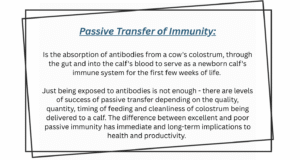
Passive transfer of immunity definition

Colostrum is the foundation of calf health. It provides the newborn calf with immunoglobulins through passive transfer that are essential for survival, disease resistance, and long-term performance. Decades of research have shown that calves with higher levels of passive immunity have lower risks of morbidity and mortality, improved growth, and better lifetime productivity. As a result, most dairy producers are well aware of the importance of feeding colostrum quickly and in sufficient volume after birth.

Despite this awareness, consistent passive immunity outcomes remain difficult to achieve on many farms. Even herds with strong colostrum management programs continue to see variability in serum immunoglobulin G (IgG) concentrations among calves. This inconsistency is often frustrating, particularly when recommended best practices for timing and volume are being followed.

A key reason for this challenge is that maternal colostrum itself is highly variable. Colostrum quality can differ substantially between cows, between calvings within the same cow, and even within the same herd on the same day. Much of this variability is driven by biological and physiological factors that are difficult, and in some cases impossible, to fully control. As a result, relying solely on maternal colostrum without a strategy to manage this variability can expose calves to higher risk of failed transfer of passive immunity.


What determines colostrum quality?

Colostrum quality is most commonly defined by its IgG concentration, as IgG is the primary antibody responsible for passive immunity in the newborn calf. While colostrum volume, cleanliness, and bacterial load are also important, IgG concentration remains the key determinant of how much immunity a calf ultimately absorbs.

The concentration of IgG in colostrum is influenced by a wide range of biological and management factors, including parity, dry cow management, and timing of colostrum collection.

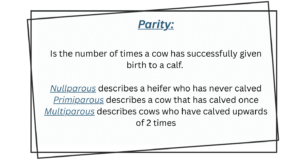
Parity definitionParity. Parity is one of the most consistent drivers of colostrum quality. Multiparous cows not only produce a greater volume of colostrum, but their colostrum typically contains higher concentrations of IgG and total protein and lower fat concentrations compared with that of first-calf heifers.

Dry cow management. Short dry periods, typically defined as less than 47 to 51 days, have been associated with reduced colostrum volume, likely due to impaired mammary cell growth or altered mammary gland function during the formation of colostrum. Prepartum nutrition, particularly energy balance and micronutrient status, can further influence immune function and colostrum synthesis. Environmental stressors, such as heat stress during late gestation, have also been associated with reduced colostrum quality.

Timing of colostrum collection. Immunoglobulin concentrations decline rapidly after calving as colostrum transitions toward mature milk. Delays in first milking, even by only a few hours, can substantially reduce IgG concentration. In fact, IgG concentration in colostrum decreases by ~4% for every one-hour delay in collection after calving.

Many of these factors interact and vary from cow to cow. Even under excellent management, it is not realistic to expect uniform colostrum quality across all calvings. This variability is not a reflection of poor management, but rather a biological reality of colostrum production.


How variable is maternal colostrum?

The extent of colostrum quality variability observed in commercial dairy herds is substantial. In a study in 2019, Dr. Sandra Godden at the University of Minnesota defined high quality colostrum as containing more than 50 g of IgG per liter. Using this standard, multiple studies have shown that a considerable proportion of colostrum fails to meet this threshold. A large study from the United States involving 104 dairy farms across 13 states found that 23% of colostrum samples were classified as poor quality (containing less than 50 g IgG/L). Similar findings have been reported in a study of 18 dairy farms in New York State, where between 20 and 24% of colostrum samples were considered poor quality, depending on cow parity.

Other production systems show even greater variability. In a study of 21 pasture-based dairy farms in Ireland, 44% of colostrum samples contained less than 50 g IgG/L, highlighting the challenges of consistently achieving high-quality colostrum in grazing systems. Canadian data shows comparable variability. A study conducted in Quebec collected colostrum samples from 51 dairy herds, and found the average IgG concentration was just above the commonly used threshold at 56 g/L. However, the distribution was wide, with IgG concentrations ranging from approximately 21 g/L to 97 g/L. Taken together, these findings suggest that ¼  to 1/5 colostrum feedings may fall below recommended quality benchmarks.

This variability means that two calves fed the same volume of colostrum at the same time after birth may receive dramatically different amounts of IgGs. In practical terms, a calf fed four liters of high-quality colostrum may receive more than double the IgG mass compared to a calf fed the same volume of poor-quality colostrum. From the calf’s perspective, these represent entirely different biological starting points.


Assessing colostrum quality

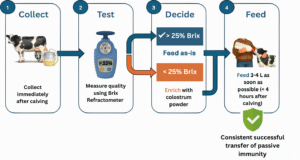
Given the inherent variability in maternal colostrum quality, assessing colostrum before feeding is an important step in reducing risk to the newborn calf. On-farm evaluation is most commonly performed using a Brix refractometer. Brix percent has been shown to correlate well with colostrum IgG concentration and provides a rapid, practical tool to support real-time decision-making.

Using a threshold of 22% Brix or greater, there is a high level of confidence that colostrum is of high quality. Specifically, Dr. Buczinski and Dr. Vandeweerd determined that colostrum measuring at least 22% Brix had a 94% probability of containing more than 50 g IgG/L in 2016. Colostrum meeting or exceeding this threshold is generally suitable for first feedings, while lower values indicate a greater risk of inadequate IgG delivery to the calf.

When used consistently, Brix testing allows farm staff to distinguish between high- and low-quality colostrum and make informed decisions about how colostrum should be allocated. This approach supports more consistent IgG delivery to calves and provides a foundation for standardized colostrum management protocols.


What can we do with poor quality colostrum?

When colostrum quality is assessed, a proportion of colostrum will fall below recommended thresholds. Discarding poor-quality colostrum is often impractical, particularly in herds with a high proportion of first-calf heifers or during periods of environmental stress. As a result, producers must decide how best to manage colostrum that does not meet quality targets while still protecting calf health.

Colostrum enrichment offers a practical solution. Enrichment involves supplementing poor-quality maternal colostrum with colostrum replacer to increase the total IgG mass delivered to the calf. This approach allows producers to maximize their own colostrum by retaining the broader bioactive components of maternal colostrum while reducing the risk associated with low IgG concentration.

The utility of this strategy was demonstrated by Dr. Lopez at the University of Guelph in 2023. In that study, enriching low-quality maternal colostrum from 30 g IgG/L to 60 g IgG/L resulted in an increase of serum IgG concentrations, from 12 g/L to 20 g/L. Arguably most importantly, they observed failure transfer of passive immunity, dropped from 19% to 0%. When maternal colostrum containing 60 g IgG/L was further enriched to 90 g IgG/L, smaller increases in serum IgG were observed. However, enrichment increased the proportion of calves achieving excellent passive immunity, defined as serum IgG concentrations greater than 25 g/L, from 50% to 62% compared with calves that were only fed the maternal colostrum measuring at 60 g IgG/L.

Together, colostrum testing and targeted enrichment provide a practical pathway toward standardized colostrum management and more predictable calf health outcomes.


Putting it all together

Steps to enrich. Collect, test, decide and feed

Taken together,

these principles support a simple, decision-based approach to colostrum management that reduces variability and improves consistency without investment in infrastructure or major increase in labour demand.

メッセージ

Colostrum quality is inherently variable, even in well-managed herds, and IgG concentration is the primary driver of passive immunity. Feeding colostrum quickly and in adequate volume is important, but it cannot overcome poor-quality colostrum, which occurs in a substantial proportion of feedings. Assessing colostrum quality using a Brix refractometer and enriching low-quality colostrum provides a practical, standardized approach to reduce variability and deliver more consistent passive immunity across calves.


Written by Dr. Dave Renaud

Veterinary Epidemiologist, University of Guelph

関連記事

初乳管理 – 牛の生涯で最も重要な食事を最大限に活かす

2026年1月宝くじに当たることを誰もが夢見るが、私は誇りを持って言える…残念ながら、わずかな額だが….

初乳相談室 – 下痢への対処法:4段階アプローチ

2025年12月新生子牛下痢(NCD)、別名スクアーズは、離乳前の子牛における最も重大な健康課題の一つであり続けている...

初乳管理の指針 – 初乳管理における総合的アプローチの重要性:栄養強化と延長給餌

2025年12月下痢は、子牛管理担当者にとって既に多忙な時期に、常に支障をきたす。.

ザ・コロストラム・カウンセル - 分娩シーズンに揃えておくべき7つのもの:獣医師の承認済みチェックリスト

2025年11月 子牛の生後24時間は最も重要である。分娩の準備として、...

子牛に最初に必要なもの

新生児を守り育てる初乳製品をお探しください。

参加する

子牛を冷やす:熱ストレスに対する初乳と移行乳の解決策

-2025年6月25日午後5時(日本時間

オンライン・ズーム・ウェビナー