


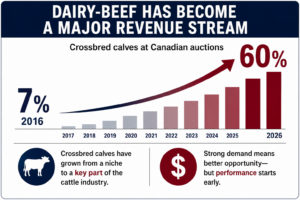
 De rundvleesindustrie heeft de afgelopen tien jaar een opmerkelijke transformatie ondergaan. Doordat de waarde van kalveren is gestegen, is de productie van melkrundvlees geëvolueerd van een bijproduct van de melkproductie naar een belangrijke inkomstenstroom voor veel melkveebedrijven. De wijdverspreide toepassing van gesekst sperma, in combinatie met een afnemende kudde vleeskoeien in Noord-Amerika, heeft deze kans voor melkveehouders gecreëerd. In Canada waren kruisingskalveren goed voor 60% van de veilingverkoop in 2025, vergeleken met slechts 7% in 2016. Daarnaast is de verkoop van rundersperma aan Amerikaanse melkveebedrijven de afgelopen vijf jaar met 260% gestegen. Tegelijkertijd proberen voederfabrieken hun hokken te vullen omdat de rundveestapel is gedaald tot het laagste niveau sinds het begin van de jaren zestig. Het resultaat is dat kalveren die ooit als moeilijk verkoopbaar werden beschouwd nu routinematig prijzen van meer dan $1400 USD opbrengen.
Met de toegenomen waarde komt echter ook een grotere controle. Voederbedrijven en kalveropfokkers erkennen al lang dat het management tijdens de eerste levensjaren op het melkveebedrijf van invloed is op de gezondheid en prestaties stroomafwaarts. A recente uitgebreide evaluatie gepubliceerd in het Journal of Dairy Science benadrukt de omvang van deze uitdaging. Het gebruik van antimicrobiële middelen bij voorgespeende melk- en rundvleeskalveren blijft extreem hoog, met darmziekten die de 85% benaderen en ademhalingsziekten die de 80% overschrijden in sommige systemen. Bovendien krijgt tussen 61% en 87% van de niet-vervangende kalveren minstens één antimicrobiële behandeling tijdens de periode vóór het spenen. Dit bevestigt dat de manier waarop deze vlees- en melkkalveren worden grootgebracht voordat ze naar de kalverhouderijen en voederplaatsen gaan, van essentieel belang is. Het bemoedigende nieuws is dat eenvoudige managementaanpassingen een grote kans bieden om de gezondheid, het welzijn en de prestaties van kalveren op de lange termijn te verbeteren.
Nieuw zuivelwetenschappelijk onderzoek bevestigt het belang van de gezondheid van kalveren in een vroeg stadium
McCarthy et al. (2026) en team van de Universiteit van Guelph een overzicht samengesteld dat specifiek gericht is op het management van rundvlees- en melkkalveren voorafgaand aan het voederen. Ze bestreken de volledige levenscyclus van genetica tot biest via transport, gebruik van antimicrobiële middelen, voeding, spenen en de impact van verschillend management op de gezondheid van de dieren in de feedlot. Hun conclusie was duidelijk: voor een duurzame productie van melk- en rundvlees moeten de uitdagingen op het gebied van gezondheid en welzijn in de periode voorafgaand aan het voederen worden aangepakt. Momenteel vallen deze dieren tussen wal en schip in vergelijking met vaarzen en vleeskalveren.
Dit onderzoek legde sterke verbanden tussen het kalvermanagement in de eerste levensuren en hoe dat doorwerkt in elke volgende productiefase. De biest die niet op tijd werd toegediend, komt naar voren als de antibioticakuur die nodig was voor een longontsteking op de leeftijd van 3 weken. Het melkvervangingsprogramma met een laag volume wordt zichtbaar als het kalf dat 3-18% van zijn lichaamsgewicht verloor tijdens transport en weken nodig had om de voeropname te herstellen. Het kalf dat onvoldoende werd gevaccineerd, slecht werd voorbereid op transport of op jonge leeftijd werd vervoerd, verschijnt op de voederplaats als een afgeprijsd dier door slechte prestaties of hoge behandelings- en ziektecijfers. Managementbeslissingen die tijdens de eerste levensweken worden genomen, beïnvloeden veel van de toekomstige gezondheids- en prestatieresultaten van een kalf, lang voordat het dier het melkveebedrijf verlaat.
Biestmanagement: De basis van de gezondheid van melkkalveren
 In het rapport van McCarthy staat wat velen in de sector al jaren constateren: niet-vervangende kalveren hebben, ondanks de recordhoge prijzen, vaak te maken met verschillende soorten kalveren. beheerspraktijken voor colostrum dan vervangende vaarzen op dezelfde boerderij. Deze kalveren worden later gevoed en krijgen biest met een hogere bacteriële besmetting en onvoldoende IgG-concentratie, wat hun kansen op een succesvolle overdracht van passieve immuniteit beperkt. Dit verklaart waarschijnlijk waarom tot 43% van de kalveren die op kalverhouderijen worden geboren, een mislukte passieve immuniteitsoverdracht (FPTI) hebben.
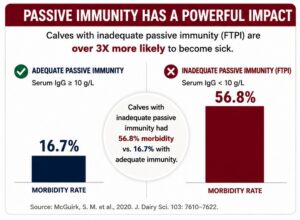
De kosten van het verkeerd aanpakken van dit probleem worden algemeen begrepen, maar zelden besproken. Uit een meta-analyse (Raboisson et al., 2016) bleek dat kalveren met FTPI twee keer zoveel risico lopen op sterfte, 1,75 keer zoveel risico lopen op boviene respiratoire aandoeningen (BRD) en 1,5 keer zoveel risico lopen op diarree. Volgens dezelfde studie kost FPTI naar schatting $70 USD per melkkalf en $92 USD per vleeskalf. Verder bleek uit een Canadese studie die kalveren onderzocht die in voederplaatsen terechtkwamen dat kalveren met onvoldoende overdracht van passieve immuniteit een ziektecijfer hadden van 56,8% in vergelijking met slechts 16,7% bij kalveren met voldoende passieve immuniteit. Kalveren met onvoldoende passieve immuniteit hadden ook ongeveer twee keer zoveel antibioticabehandelingen nodig tijdens de voederperiode (Abdallah et al., 2022).
Hoe ziet dit er in de praktijk uit? Voor een melkveebedrijf met 400 kalveren en een FTPI van 30% betekent dit 120 kalveren tegen ruwweg $70 tot $92 USD/hd aan directe kosten. Voordat rekening wordt gehouden met verloren gewichtstoename, vertraagd herstel, arbeidsvraag, verhoogd risico op toekomstige behandelingen en korting op de feedlot, is dit $8.400 tot $11.040 USD schade door het niet tijdig leveren van biest van goede kwaliteit.
Het antibioticaprobleem: geen strategie maar een symptoom
Misschien wel de meest opvallende bevinding in de McCarthy review is deze: 61-87% van de niet-vervangende kalveren krijgt minstens één antibioticabehandeling tijdens de periode voor het spenen. In sommige systemen bedraagt de morbiditeit bij darmen bijna 85% en bij ademhalingsproblemen meer dan 80%.
Deze bevindingen benadrukken een kritieke uitdaging voor de gezondheid van kalveren in de zuivel- en rundvleessector. Hoewel antibiotica een essentieel diergeneeskundig hulpmiddel blijven, kan de focus op ziektepreventie door het verbeteren van biestmanagement, voeding, huisvesting en transportpraktijken de ziektedruk en de behoefte aan behandeling verminderen.
De EU heeft al stappen ondernomen om het profylactische en metafylactische gebruik van antimicrobiële stoffen te beperken op grond van de verordeningen EU 2019/6 en EU 2019/4. In Canada en de VS zijn alle medisch belangrijke antimicrobiële stoffen sinds respectievelijk december 2018 en juni 2023 alleen nog op recept verkrijgbaar. Het traject is duidelijk. Naarmate de regelgeving en de marktverwachtingen blijven evolueren, zullen producenten die investeren in ziektepreventie en antimicrobieel stewardship het best geplaatst zijn om te slagen.
Door dierenartsen aanbevolen oplossingen voor gezondere melkveekalveren
De review belicht verschillende veelbelovende strategieën die de afhankelijkheid van antimicrobiële middelen verminderen zonder het dierenwelzijn in gevaar te brengen:
- Risicogebaseerde classificatie bij aankomst. In plaats van elk kalf te behandelen, kun je objectieve indicatoren bij aankomst gebruiken, zoals uitdroging, verzonken flanken, navelaandoeningen en serum totaal eiwit om kalveren met het grootste risico op ziekte te identificeren. Door de behandeling te richten op kalveren met een hoog risico, kan het antibioticagebruik aanzienlijk worden teruggedrongen, terwijl de dieren die er het meeste baat bij hebben, toch worden behandeld. Von Konigslow et al. (2025) ontdekten dat deze aanpak het gebruik van antimicrobiële middelen effectief verminderde bij kalveren in de rundveehouderij, hoewel de mortaliteitsresultaten voortdurend in de gaten moeten worden gehouden.
- Uitgebreide biestvoeding. Het verstrekken van biest gedurende de eerste twee weken na aankomst aan niet-vervangende kalveren in een opfokbedrijf verminderde de incidentie van diarree bij kalveren met een laag serum IgG (Wang et al., 2025). Dit is een praktische, low-tech interventie die de voordelen van colostrum voor de darmgezondheid benut buiten de traditionele eerste dag.
- Colostrum als therapie. Carter et al. (2022) toonden aan dat het voeren van colostrum bij het begin van diarree de oplossing versnelde, wat een mogelijk alternatief is voor antibiotische behandeling van darmziekten.
- Betere melkvervangersamenstelling. Profylactische antimicrobiële middelen in gemedicineerde melkvervangers hebben inconsistente of negatieve effecten laten zien op de gezondheid van kalveren en de darmmicrobiota (Berge et al., 2009; Buss et al., 2021; Cangiano et al., 2023). Het vervangen van gemedicineerde MR door niet-gemedicineerde formules van hogere kwaliteit die voldoende vet en eiwit bevatten, kan het onderliggende voedingstekort aanpakken dat de vatbaarheid voor ziekten veroorzaakt.
Er zijn ook nieuwe aanwijzingen dat kruisingskalveren minder antimicrobiële behandelingen nodig hebben dan Holstein-mannetjes (McCarthy et al., 2025), mogelijk vanwege een betere overdracht van passieve immuniteit bij lagere biestvolumes. Dit is een ander inherent voordeel van de genetica van rundvee op melkvee, dat teniet wordt gedaan als het biestmanagement ontoereikend is.
Conclusie
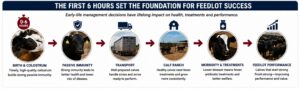
Het leven van een rundvlees- of melkkalf begint niet bij de feedlot, maar bij de melkfabriek. De moderne wetenschap blijft aantonen dat biestmanagement, passieve immuniteit, voeding en de verzorging van het kalf op jonge leeftijd een blijvende invloed hebben op de gezondheid, het antibioticagebruik, het welzijn en de prestaties van de diervoederfabriek.
Nu melkkalveren een steeds waardevoller onderdeel worden van de Noord-Amerikaanse rundvleesproductie, hebben producenten een unieke kans om de resultaten te verbeteren door middel van op feiten gebaseerd en economisch onderbouwd management. Het snel en consequent verstrekken van biest van hoge kwaliteit blijft een van de meest effectieve investeringen die een producent kan doen om de gezondheid en productiviteit van kalveren op de lange termijn te verbeteren.
De feedlot erkent de waarde van een gezond kalf al. De wetenschap bevestigt het. De economie ondersteunt het. De vraag is niet langer of vlees- of melkkalveren de investering waard zijn, maar of producenten het zich kunnen veroorloven om de managementpraktijken over het hoofd te zien die bepalend zijn voor hun toekomstige succes.
Leer meer over hoe u kalveren kunt optimaliseren voor toekomstig succes met SCCL's Colostrumbeheer op de boerderij
Sydney Fortier, M.Sc.
Specialist marketingcommunicatie, SCCL