


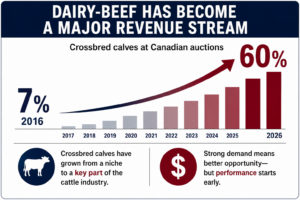
 W ciągu ostatniej dekady przemysł mleczarski przeszedł niezwykłą transformację. Wraz ze wzrostem wartości cieląt, produkcja wołowiny mlecznej przekształciła się z produktu ubocznego produkcji mleka w ważny strumień przychodów dla wielu gospodarstw mlecznych. Powszechne stosowanie nasienia seksowanego, w połączeniu z malejącym stadem krów mięsnych w Ameryce Północnej, stworzyło taką możliwość dla hodowców bydła mlecznego. W Kanadzie cielęta mieszańce stanowiły 60% sprzedaży na rynku aukcyjnym w 2025 roku, w porównaniu do zaledwie 7% w 2016 roku. Ponadto sprzedaż nasienia wołowego do amerykańskich mleczarni wzrosła o 260% w ciągu ostatnich pięciu lat. W tym samym czasie paszarnie starają się zapełnić kojce, ponieważ stado krów wołowych spadło do najniższego poziomu od wczesnych lat 60-tych. W rezultacie cielęta, które kiedyś były postrzegane jako trudne do wprowadzenia na rynek, obecnie rutynowo osiągają ceny przekraczające $1400 USD.
Jednak wraz ze wzrostem wartości wzrasta kontrola. Paszarnie i hodowcy cieląt od dawna zdają sobie sprawę, że zarządzanie wczesnym okresem życia w gospodarstwie mlecznym wpływa na zdrowie i wydajność. A niedawny kompleksowy przegląd opublikowany w Journal of Dairy Science podkreśla skalę tego wyzwania. Stosowanie środków przeciwdrobnoustrojowych u cieląt przed odsadzeniem od maciory pozostaje niezwykle wysokie, a wskaźniki zachorowalności na choroby jelit zbliżają się do 85%, a zachorowalność na choroby układu oddechowego przekracza 80% w niektórych systemach. Co więcej, od 61% do 87% cieląt niezastępowanych otrzymuje co najmniej jedno leczenie przeciwdrobnoustrojowe w okresie przed odsadzeniem. Potwierdza to, że sposób, w jaki te cielęta są hodowane, zanim trafią na rancza cieląt i feedloty, jest niezbędny. Optymistyczną wiadomością jest to, że proste korekty w zarządzaniu oferują dużą szansę na poprawę zdrowia, dobrostanu i długoterminowej wydajności cieląt.
Nowe badania naukowe w dziedzinie mleczarstwa potwierdzają znaczenie wczesnego zdrowia cieląt
McCarthy et al. (2026) i zespół z University of Guelph przygotowała przegląd koncentrujący się w szczególności na zarządzaniu przedubojowym cieląt mlecznych. Obejmował on cały cykl życia, od genetyki po siarę, poprzez transport, stosowanie środków przeciwdrobnoustrojowych, żywienie, odsadzanie i wpływ różnych metod zarządzania na zdrowie przedubojowe. Ich wniosek był jasny: aby produkcja wołowiny mlecznej była zrównoważona, należy zająć się wyzwaniami związanymi ze zdrowiem i dobrostanem zwierząt w okresie przedubojowym. Obecnie zwierzęta te są pomijane w porównaniu z cielętami jałówek mlecznych i cielętami ras mięsnych.
Przegląd ten wykazał silne powiązania między zarządzaniem cielętami w ciągu pierwszych kilku godzin życia i tym, jak wpływa to na każdy kolejny etap produkcji. Siara, która nie została dostarczona w odpowiednim czasie, pojawia się jako antybiotykoterapia wymagana w przypadku zapalenia płuc w wieku 3 tygodni. Program małej ilości preparatów mlekozastępczych objawia się jako cielę, które straciło 3-18% masy ciała podczas transportu i potrzebowało tygodni, aby odzyskać spożycie paszy. Cielę, które zostało nieodpowiednio zaszczepione, źle przygotowane do transportu lub wysłane w młodym wieku, pojawia się w punkcie żywienia jako zwierzę z dyskontem z powodu słabej wydajności lub wysokiego wskaźnika leczenia i zachorowalności. Decyzje dotyczące zarządzania podejmowane w ciągu pierwszych kilku tygodni życia wpływają na wiele przyszłych wyników zdrowotnych i wydajnościowych cielęcia, na długo zanim jeszcze opuści ono gospodarstwo mleczne.
Zarządzanie siarą: Podstawa zdrowia cieląt ras mlecznych i pszczół
 Raport McCarthy'ego przedstawia to, co wielu w branży zaobserwowało od lat: cielęta niezastępcze, pomimo rekordowo wysokich cen, często doświadczają różnych skutków. praktyki zarządzania siarą niż jałówki zastępcze w tym samym gospodarstwie. Cielęta te są karmione później i otrzymują siarę o wyższym skażeniu bakteryjnym i niewystarczającym stężeniu IgG, co ogranicza ich szanse na pomyślne przeniesienie odporności biernej. To prawdopodobnie wyjaśnia, dlaczego do 43% cieląt trafiających na rancza cieląt ma niepowodzenie biernego transferu odporności (FPTI).
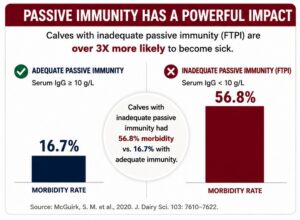
Koszt popełnienia tego błędu jest powszechnie znany, ale rzadko się o nim mówi. Metaanaliza (Raboisson i in., 2016) wykazała, że cielęta z FTPI są dwukrotnie bardziej narażone na śmiertelność, 1,75 razy bardziej narażone na choroby układu oddechowego bydła (BRD) i 1,5 razy bardziej narażone na biegunkę. W tym samym badaniu oszacowano, że FPTI kosztuje $70 USD na cielę mleczne i $92 USD na cielę wołowe. Co więcej, kanadyjskie badanie cieląt wprowadzanych do paszy wykazało, że cielęta z niewystarczającym transferem odporności biernej miały wskaźnik zachorowalności wynoszący 56,8% w porównaniu z zaledwie 16,7% wśród cieląt z odpowiednią odpornością bierną. Cielęta z niewystarczającą odpornością bierną wymagały również około dwukrotnie większej liczby antybiotykoterapii w okresie karmienia (Abdallah i in., 2022).
Jak to wygląda w praktyce? Dla mleczarni liczącej 400 cieląt ze wskaźnikiem FTPI 30% oznacza to 120 cieląt przy kosztach bezpośrednich wynoszących od $70 do $92 USD/hd. Przed uwzględnieniem utraconego przyrostu masy ciała, opóźnionego powrotu do zdrowia, zapotrzebowania na siłę roboczą, zwiększonego ryzyka przyszłych zabiegów i rabatu w porodówce, jest to od $8,400 do $11,040 USD straty za niedostarczenie siary wysokiej jakości na czas.
Problem antybiotyków: objaw, a nie strategia
Być może najbardziej uderzającym odkryciem w przeglądzie McCarthy'ego jest to: 61-87% cieląt niezastępowanych otrzymuje co najmniej jedną kurację antybiotykową w okresie przed odsadzeniem. W niektórych systemach zachorowalność na choroby jelit zbliża się do 85%, a zachorowalność na choroby układu oddechowego przekracza 80%.
Wyniki te podkreślają krytyczne wyzwanie dla zdrowia cieląt w przemyśle mleczarskim. Podczas gdy antybiotyki pozostają niezbędnym narzędziem weterynaryjnym, skupienie się na zapobieganiu zachorowalności poprzez poprawę zarządzania siarą, żywienia, praktyk mieszkaniowych i transportowych może zmniejszyć presję chorobową i potrzebę leczenia.
UE podjęła już kroki w celu ograniczenia profilaktycznego i metafilaktycznego stosowania środków przeciwdrobnoustrojowych na mocy rozporządzeń UE 2019/6 i UE 2019/4. W Kanadzie i Stanach Zjednoczonych, odpowiednio od grudnia 2018 r. i czerwca 2023 r., wszystkie medycznie ważne środki przeciwdrobnoustrojowe są wydawane wyłącznie na receptę. Trajektoria jest jasna. Ponieważ oczekiwania regulacyjne i rynkowe nadal ewoluują, producenci, którzy inwestują w zapobieganie chorobom i zarządzanie środkami przeciwdrobnoustrojowymi, będą najlepiej przygotowani do odniesienia sukcesu.
Zalecane przez weterynarzy rozwiązania dla zdrowszych cieląt mlecznych
W przeglądzie podkreślono kilka obiecujących strategii, które zmniejszają zależność od środków przeciwdrobnoustrojowych bez narażania dobrostanu zwierząt:
- Klasyfikacja oparta na ryzyku w momencie przybycia. Zamiast leczyć każde cielę, użyj obiektywnych wskaźników w momencie przybycia, takich jak stan odwodnienia, zapadnięte boki, choroba pępka, całkowite białko w surowicy, aby zidentyfikować cielęta najbardziej zagrożone chorobą. Ukierunkowanie leczenia na cielęta wysokiego ryzyka może znacznie zmniejszyć zużycie antybiotyków, zapewniając jednocześnie, że zwierzęta, które najprawdopodobniej odniosą korzyści, nadal otrzymają interwencję. Von Konigslow i in. (2025) stwierdzili, że podejście to skutecznie zmniejszyło zużycie środków przeciwdrobnoustrojowych u cieląt mlecznych, choć wyniki śmiertelności wymagają dalszego monitorowania.
- Przedłużone karmienie siarą. Dostarczanie siary przez pierwsze dwa tygodnie po przybyciu cielętom niezastępowanym w odchowalni zmniejszyło częstość występowania biegunki u cieląt z niskim poziomem IgG w surowicy (Wang i in., 2025). Jest to praktyczna, mało zaawansowana technologicznie interwencja, która wykorzystuje korzyści zdrowotne siary dla jelit poza tradycyjnym okresem pierwszego dnia.
- Colostrum jako terapia. Carter i wsp. (2022) wykazali, że karmienie siarą na początku biegunki przyspieszyło jej ustąpienie, oferując możliwą alternatywę dla antybiotykoterapii chorób jelit.
- Lepszy preparat mlekozastępczy. Profilaktyczne środki przeciwdrobnoustrojowe w leczniczych preparatach mlekozastępczych wykazały niespójny lub negatywny wpływ na zdrowie cieląt i mikroflorę jelitową (Berge i in., 2009; Buss i in., 2021; Cangiano i in., 2023). Zastąpienie leczniczych preparatów MR preparatami o wyższej jakości, nieleczniczymi, które zawierają odpowiedni tłuszcz i białko, może rozwiązać podstawowy niedobór żywieniowy powodujący podatność na choroby.
Pojawiające się dowody sugerują również, że cielęta mieszańców mogą wymagać mniejszej liczby zabiegów przeciwdrobnoustrojowych niż samce rasy holsztyńskiej (McCarthy i in., 2025), potencjalnie z powodu lepszego transferu odporności biernej przy niższych objętościach siary. Jest to kolejna nieodłączna zaleta genetyki bydła mlecznego, która zostaje zniwelowana, gdy zarządzanie siarą jest nieodpowiednie.
Podsumowując
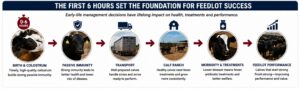
Życie cielęcia nie zaczyna się na stanowisku paszowym, ale w mleczarni. Współczesna nauka nieustannie pokazuje, że zarządzanie siarą, odporność bierna, żywienie i opieka nad cielętami we wczesnym okresie życia mają trwały wpływ na zdrowie, stosowanie antybiotyków, dobrostan i wydajność na stanowisku paszowym.
Ponieważ cielęta mleczne stają się coraz bardziej wartościowym składnikiem produkcji wołowiny w Ameryce Północnej, producenci mają wyjątkową okazję do poprawy wyników poprzez zarządzanie oparte na dowodach i ekonomii. Szybkie i konsekwentne dostarczanie wysokiej jakości siary pozostaje jedną z najskuteczniejszych inwestycji, jakie producent może poczynić w celu poprawy zdrowia i wydajności cieląt w perspektywie długoterminowej.
Feedlot już dostrzega wartość zdrowego cielęcia. Nauka to potwierdza. Ekonomia to potwierdza. Pytanie nie brzmi już, czy wołowina i cielęta mleczne są warte inwestycji, ale czy producenci mogą sobie pozwolić na przeoczenie praktyk zarządzania, które kształtują ich przyszły sukces.
Dowiedz się więcej o tym, jak zoptymalizować cielęta pod kątem przyszłego sukcesu dzięki SCCL Przewodnik zarządzania siarą w gospodarstwie
Sydney Fortier, M.Sc.
Specjalista ds. komunikacji marketingowej, SCCL