


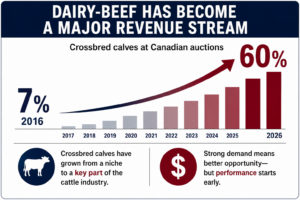
 L'industrie de la viande bovine et des produits laitiers a connu une transformation remarquable au cours de la dernière décennie. Avec l'augmentation de la valeur des veaux, la production de viande bovine laitière est passée du statut de sous-produit de la production laitière à celui de source de revenus importante pour de nombreuses exploitations laitières. L'adoption généralisée de la semence sexée, combinée au déclin du cheptel de vaches de boucherie en Amérique du Nord, a créé cette opportunité pour les producteurs laitiers. Au Canada, les veaux croisés représentaient 60% des ventes aux enchères en 2025, contre seulement 7% en 2016. En outre, les ventes de semence de bœuf aux laiteries américaines ont augmenté de 260% au cours des cinq dernières années. Dans le même temps, les parcs d'engraissement s'efforcent de remplir les enclos car le cheptel de vaches de boucherie est tombé à son niveau le plus bas depuis le début des années 1960. En conséquence, les veaux qui étaient autrefois considérés comme difficiles à commercialiser atteignent aujourd'hui régulièrement des prix supérieurs à $1400 USD.
Cependant, l'augmentation de la valeur s'accompagne d'un examen plus approfondi. Les parcs d'engraissement et les éleveurs de veaux reconnaissent depuis longtemps que la gestion du début de la vie dans l'exploitation laitière influence la santé et les performances en aval. A examen approfondi récent publiée dans le Journal of Dairy Science souligne l'ampleur de ce défi. L'utilisation d'antimicrobiens chez les veaux de boucherie laitiers pré-sevrés reste extrêmement élevée, avec des taux de morbidité entérique proches de 85% et une morbidité respiratoire supérieure à 80% dans certains systèmes. En outre, entre 61% et 87% des veaux de non-remplacement reçoivent au moins un traitement antimicrobien pendant la période de pré-sevrage. Cela confirme qu'il est impératif d'élever les veaux de boucherie et les veaux laitiers avant qu'ils n'arrivent dans les ranchs à veaux et les parcs d'engraissement. La nouvelle encourageante est que de simples ajustements de gestion offrent une opportunité majeure d'améliorer la santé, le bien-être et les performances à long terme des veaux.
Une nouvelle recherche en sciences laitières confirme l'importance de la santé des veaux à un stade précoce
McCarthy et al. (2026) et l'équipe de l'Université de Guelph a réalisé une étude portant spécifiquement sur la gestion des veaux de boucherie et des veaux laitiers avant l'entrée au parc d'engraissement. Ils ont couvert l'ensemble du cycle de vie, de la génétique au colostrum en passant par le transport, l'utilisation d'antimicrobiens, la nutrition, le sevrage et l'impact des différentes gestions sur la santé en parc d'engraissement. Leur conclusion était claire : pour que la production de viande bovine laitière soit durable, il faut s'attaquer aux problèmes de santé et de bien-être de la période précédant l'entrée en parc d'engraissement. Actuellement, ces animaux passent à travers les mailles du filet par rapport aux génisses laitières et aux veaux de boucherie de race pure.
Cette étude établit des liens étroits entre la gestion des veaux au cours des premières heures de leur vie et la façon dont cette gestion se répercute à tous les stades ultérieurs de la production. Le colostrum qui n'a pas été distribué en temps voulu se traduit par un traitement antibiotique nécessaire pour une pneumonie à l'âge de trois semaines. Le programme d'allaitement à faible volume se traduit par un veau qui a perdu 3-18% de son poids corporel pendant le transport et qui a mis des semaines à récupérer sa consommation d'aliments. Le veau qui a été mal vacciné, mal préparé pour le transport ou expédié à un jeune âge se présente au parc d'engraissement comme un animal décoté en raison de ses mauvaises performances ou de ses taux élevés de traitement et de morbidité. Les décisions de gestion prises au cours des premières semaines de vie influencent la santé et les performances futures du veau, bien avant qu'il ne quitte l'exploitation laitière.
Gestion du colostrum : La base de la santé du veau laitier et du veau de boucherie
 Le rapport McCarthy expose ce que de nombreux acteurs du secteur observent depuis des années : les veaux de non-remplacement, malgré des prix record, connaissent souvent des situations différentes de celles des veaux de remplacement. pratiques de gestion du colostrum que les génisses de remplacement de la même exploitation. Ces veaux sont nourris plus tard et reçoivent un colostrum plus contaminé par les bactéries et dont la concentration en IgG est insuffisante, ce qui limite leurs chances de réussir le transfert de l'immunité passive. Cela explique probablement pourquoi jusqu'à 43% des veaux frappant les ranchs à veaux présentent un échec du transfert passif de l'immunité (FPTI).
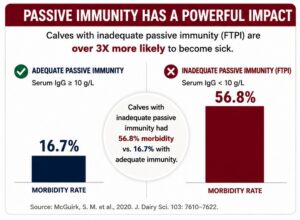
Le coût d'une telle erreur est largement compris mais rarement évoqué. Une méta-analyse (Raboisson et al., 2016) a révélé que les veaux atteints d'IPTF courent deux fois plus de risques de mortalité, 1,75 fois plus de risques de maladie respiratoire bovine (MRB) et 1,5 fois plus de risques de diarrhée. La même étude a estimé que l'IPTF coûtait $70 USD par veau laitier et $92 USD par veau de boucherie. Par ailleurs, une étude canadienne portant sur des veaux entrant dans des parcs d'engraissement a révélé que les veaux dont le transfert d'immunité passive était insuffisant présentaient un taux de morbidité de 56,8%, contre seulement 16,7% chez les veaux dont l'immunité passive était suffisante. Les veaux dont l'immunité passive est insuffisante ont également nécessité environ deux fois plus de traitements antibiotiques pendant la période d'engraissement (Abdallah et al., 2022).
Comment cela se traduit-il dans la pratique ? Pour une exploitation laitière de 400 veaux avec un taux d'IPTF de 30%, cela signifie 120 veaux pour un coût direct de $70 à $92 USD/jour. Avant de tenir compte de la perte de poids, du retard de récupération, de la demande de main-d'œuvre, du risque accru de traitements futurs et de la décote au parc d'engraissement, cela représente entre 8 400 et 11 040 USD de frais pour ne pas avoir fourni un colostrum de qualité en temps voulu.
Le problème des antibiotiques : un symptôme, pas une stratégie
La conclusion la plus frappante de l'étude McCarthy est peut-être la suivante : 61-87% des veaux non remplacés reçoivent au moins un traitement antibiotique pendant la période de pré-sevrage. Dans certains systèmes, la morbidité entérique approche 85% et la morbidité respiratoire dépasse 80%.
Ces résultats mettent en évidence un défi majeur pour la santé des veaux dans le secteur de la production laitière et de la viande bovine. Si les antibiotiques restent un outil vétérinaire essentiel, la prévention de la morbidité par l'amélioration de la gestion du colostrum, de l'alimentation, du logement et des pratiques de transport peut réduire la pression de la maladie et la nécessité d'un traitement.
L'UE a déjà pris des mesures pour restreindre l'utilisation prophylactique et métaphylactique des antimicrobiens dans le cadre des règlements UE 2019/6 et UE 2019/4. Au Canada et aux États-Unis, depuis décembre 2018 et juin 2023 respectivement, tous les antimicrobiens d'importance médicale ne peuvent être délivrés que sur ordonnance. La trajectoire est claire. Alors que les attentes réglementaires et commerciales continuent d'évoluer, les producteurs qui investissent dans la prévention des maladies et la gestion des antimicrobiens seront les mieux placés pour réussir.
Solutions recommandées par les vétérinaires pour des veaux laitiers en meilleure santé
L'étude met en évidence plusieurs stratégies prometteuses qui réduisent la dépendance aux antimicrobiens sans compromettre le bien-être des animaux :
- Classification basée sur le risque à l'arrivée. Plutôt que de traiter chaque veau, il convient d'utiliser des indicateurs objectifs à l'arrivée, tels que l'état de déshydratation, le flanc creux, la maladie ombilicale, la protéine totale sérique, afin d'identifier les veaux présentant le plus grand risque de maladie. Cibler le traitement sur les veaux à haut risque permet de réduire considérablement l'utilisation d'antibiotiques tout en garantissant que les animaux les plus susceptibles d'en bénéficier bénéficient toujours de l'intervention. Von Konigslow et al. (2025) ont constaté que cette approche permettait de réduire efficacement l'utilisation d'antimicrobiens chez les veaux de boucherie et les veaux laitiers, bien que les résultats en termes de mortalité nécessitent un suivi continu.
- Alimentation prolongée en colostrum. L'administration de colostrum pendant les deux premières semaines suivant l'arrivée des veaux non remplacés dans une installation d'élevage a permis de réduire l'incidence de la diarrhée chez les veaux ayant un faible taux d'IgG sérique (Wang et al., 2025). Il s'agit d'une intervention pratique et peu technique qui exploite les avantages du colostrum pour la santé intestinale au-delà de la fenêtre traditionnelle du premier jour.
- Le colostrum comme thérapie. Carter et al. (2022) ont démontré que l'administration de colostrum dès l'apparition de la diarrhée en accélère la résolution, offrant ainsi une alternative possible au traitement antibiotique des maladies entériques.
- Meilleure formulation de l'aliment d'allaitement. Les antimicrobiens prophylactiques contenus dans les aliments d'allaitement médicamenteux ont eu des effets contradictoires ou négatifs sur la santé des veaux et le microbiote intestinal (Berge et al., 2009 ; Buss et al., 2021 ; Cangiano et al., 2023). Le remplacement du lait d'allaitement médicamenteux par des formulations de meilleure qualité, non médicamenteuses, contenant suffisamment de matières grasses et de protéines, peut permettre de remédier aux carences nutritionnelles sous-jacentes à l'origine de la susceptibilité aux maladies.
De nouvelles preuves suggèrent également que les veaux croisés peuvent nécessiter moins de traitements antimicrobiens que les mâles Holstein (McCarthy et al., 2025), potentiellement en raison d'un meilleur transfert d'immunité passive avec des volumes de colostrum plus faibles. Il s'agit là d'un autre avantage inhérent à la génétique des bovins laitiers, qui disparaît lorsque la gestion du colostrum est inadéquate.
En conclusion
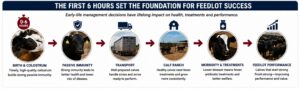
La vie d'un veau de boucherie ne commence pas au parc d'engraissement, mais à la laiterie. La science moderne continue de démontrer que la gestion du colostrum, l'immunité passive, la nutrition et les soins apportés au veau en début de vie ont un impact durable sur la santé, l'utilisation d'antibiotiques, le bien-être et les performances du parc d'engraissement.
Alors que les veaux de boucherie et les veaux laitiers deviennent une composante de plus en plus précieuse de la production de viande bovine en Amérique du Nord, les producteurs ont une occasion unique d'améliorer les résultats grâce à une gestion fondée sur des données probantes et sur des considérations économiques. L'administration rapide et constante d'un colostrum de haute qualité reste l'un des investissements les plus efficaces qu'un producteur puisse faire pour améliorer la santé et la productivité des veaux à long terme.
Le parc d'engraissement reconnaît déjà la valeur d'un veau en bonne santé. La science le confirme. L'économie le confirme. La question n'est plus de savoir si les veaux de boucherie ou les veaux laitiers valent l'investissement, mais si les producteurs peuvent se permettre de négliger les pratiques de gestion qui conditionnent leur réussite future.
Pour en savoir plus sur la manière d'optimiser les veaux en vue d'une réussite future, consultez le site de SCCL Guide de gestion du colostrum à la ferme
Sydney Fortier, M.Sc.
Spécialiste en communication marketing, SCCL