



Colostrum is the foundation of calf health. It provides the newborn calf with immunoglobulins through passive transfer that are essential for survival, disease resistance, and long-term performance. Decades of research have shown that calves with higher levels of passive immunity have lower risks of morbidity and mortality, improved growth, and better lifetime productivity. As a result, most dairy producers are well aware of the importance of feeding colostrum quickly and in sufficient volume after birth.
Despite this awareness, consistent passive immunity outcomes remain difficult to achieve on many farms. Even herds with strong colostrum management programs continue to see variability in serum immunoglobulin G (IgG) concentrations among calves. This inconsistency is often frustrating, particularly when recommended best practices for timing and volume are being followed.
A key reason for this challenge is that maternal colostrum itself is highly variable. Colostrum quality can differ substantially between cows, between calvings within the same cow, and even within the same herd on the same day. Much of this variability is driven by biological and physiological factors that are difficult, and in some cases impossible, to fully control. As a result, relying solely on maternal colostrum without a strategy to manage this variability can expose calves to higher risk of failed transfer of passive immunity.
What determines colostrum quality?
Colostrum quality is most commonly defined by its IgG concentration, as IgG is the primary antibody responsible for passive immunity in the newborn calf. While colostrum volume, cleanliness, and bacterial load are also important, IgG concentration remains the key determinant of how much immunity a calf ultimately absorbs.
The concentration of IgG in colostrum is influenced by a wide range of biological and management factors, including parity, dry cow management, and timing of colostrum collection.
 Parity. Parity is one of the most consistent drivers of colostrum quality. Multiparous cows not only produce a greater volume of colostrum, but their colostrum typically contains higher concentrations of IgG and total protein and lower fat concentrations compared with that of first-calf heifers.
Dry cow management. Short dry periods, typically defined as less than 47 to 51 days, have been associated with reduced colostrum volume, likely due to impaired mammary cell growth or altered mammary gland function during the formation of colostrum. Prepartum nutrition, particularly energy balance and micronutrient status, can further influence immune function and colostrum synthesis. Environmental stressors, such as heat stress during late gestation, have also been associated with reduced colostrum quality.
Timing of colostrum collection. Immunoglobulin concentrations decline rapidly after calving as colostrum transitions toward mature milk. Delays in first milking, even by only a few hours, can substantially reduce IgG concentration. In fact, IgG concentration in colostrum decreases by ~4% for every one-hour delay in collection after calving.
Many of these factors interact and vary from cow to cow. Even under excellent management, it is not realistic to expect uniform colostrum quality across all calvings. This variability is not a reflection of poor management, but rather a biological reality of colostrum production.
How variable is maternal colostrum?
The extent of colostrum quality variability observed in commercial dairy herds is substantial. In a study in 2019, Dr. Sandra Godden at the University of Minnesota defined high quality colostrum as containing more than 50 g of IgG per liter. Using this standard, multiple studies have shown that a considerable proportion of colostrum fails to meet this threshold. A large study from the United States involving 104 dairy farms across 13 states found that 23% of colostrum samples were classified as poor quality (containing less than 50 g IgG/L). Similar findings have been reported in a study of 18 dairy farms in New York State, where between 20 and 24% of colostrum samples were considered poor quality, depending on cow parity.
Other production systems show even greater variability. In a study of 21 pasture-based dairy farms in Ireland, 44% of colostrum samples contained less than 50 g IgG/L, highlighting the challenges of consistently achieving high-quality colostrum in grazing systems. Canadian data shows comparable variability. A study conducted in Quebec collected colostrum samples from 51 dairy herds, and found the average IgG concentration was just above the commonly used threshold at 56 g/L. However, the distribution was wide, with IgG concentrations ranging from approximately 21 g/L to 97 g/L. Taken together, these findings suggest that ¼ to 1/5 colostrum feedings may fall below recommended quality benchmarks.
This variability means that two calves fed the same volume of colostrum at the same time after birth may receive dramatically different amounts of IgGs. In practical terms, a calf fed four liters of high-quality colostrum may receive more than double the IgG mass compared to a calf fed the same volume of poor-quality colostrum. From the calf’s perspective, these represent entirely different biological starting points.
Assessing colostrum quality
Given the inherent variability in maternal colostrum quality, assessing colostrum before feeding is an important step in reducing risk to the newborn calf. On-farm evaluation is most commonly performed using a Brix refractometer. Brix percent has been shown to correlate well with colostrum IgG concentration and provides a rapid, practical tool to support real-time decision-making.
Using a threshold of 22% Brix or greater, there is a high level of confidence that colostrum is of high quality. Specifically, Dr. Buczinski and Dr. Vandeweerd determined that colostrum measuring at least 22% Brix had a 94% probability of containing more than 50 g IgG/L in 2016. Colostrum meeting or exceeding this threshold is generally suitable for first feedings, while lower values indicate a greater risk of inadequate IgG delivery to the calf.
When used consistently, Brix testing allows farm staff to distinguish between high- and low-quality colostrum and make informed decisions about how colostrum should be allocated. This approach supports more consistent IgG delivery to calves and provides a foundation for standardized colostrum management protocols.
What can we do with poor quality colostrum?
When colostrum quality is assessed, a proportion of colostrum will fall below recommended thresholds. Discarding poor-quality colostrum is often impractical, particularly in herds with a high proportion of first-calf heifers or during periods of environmental stress. As a result, producers must decide how best to manage colostrum that does not meet quality targets while still protecting calf health.
Colostrum enrichment offers a practical solution. Enrichment involves supplementing poor-quality maternal colostrum with colostrum replacer to increase the total IgG mass delivered to the calf. This approach allows producers to maximize their own colostrum by retaining the broader bioactive components of maternal colostrum while reducing the risk associated with low IgG concentration.
The utility of this strategy was demonstrated by Dr. Lopez at the University of Guelph in 2023. In that study, enriching low-quality maternal colostrum from 30 g IgG/L to 60 g IgG/L resulted in an increase of serum IgG concentrations, from 12 g/L to 20 g/L. Arguably most importantly, they observed failure transfer of passive immunity, dropped from 19% to 0%. When maternal colostrum containing 60 g IgG/L was further enriched to 90 g IgG/L, smaller increases in serum IgG were observed. However, enrichment increased the proportion of calves achieving excellent passive immunity, defined as serum IgG concentrations greater than 25 g/L, from 50% to 62% compared with calves that were only fed the maternal colostrum measuring at 60 g IgG/L.
Together, colostrum testing and targeted enrichment provide a practical pathway toward standardized colostrum management and more predictable calf health outcomes.
Putting it all together
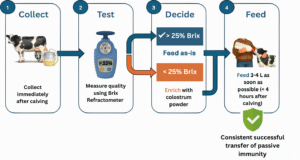
Taken together,
these principles support a simple, decision-based approach to colostrum management that reduces variability and improves consistency without investment in infrastructure or major increase in labour demand.
Mensajes para llevar a casa
Colostrum quality is inherently variable, even in well-managed herds, and IgG concentration is the primary driver of passive immunity. Feeding colostrum quickly and in adequate volume is important, but it cannot overcome poor-quality colostrum, which occurs in a substantial proportion of feedings. Assessing colostrum quality using a Brix refractometer and enriching low-quality colostrum provides a practical, standardized approach to reduce variability and deliver more consistent passive immunity across calves.
Written by Dr. Dave Renaud
Veterinary Epidemiologist, University of Guelph