


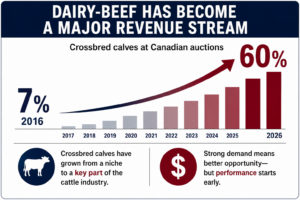
 The beef on dairy industry has undergone remarkable transformation over the past decade. As calf values have increased, dairy-beef production has evolved from a by-product of milk production into an important revenue stream for many dairy farms. The widespread adoption of sexed semen, combined with a declining North American beef cow herd, has created this opportunity for dairy farmers. In Canada, crossbred calves accounted for 60% of auction market sales in 2025, compared with just 7% in 2016. Additionally, beef semen sales to US dairies has grown by 260% over the past five years. At the same time, feedlots are scrambling to fill pens as the beef cow herd has fallen to its lowest level since the early 1960s. As a result, calves that were once viewed as difficult to market now routinely command prices exceeding $1400 USD.
However, with increased value comes increased scrutiny. Feedlots and calf raisers have long recognized that early-life management on the dairy farm influences downstream health and performance. A recent comprehensive review published in the Journal of Dairy Science highlights the magnitude of this challenge. Antimicrobial use in preweaned dairy-beef calves remains extremely high, with enteric morbidity rates approaching 85% and respiratory morbidity exceeding 80% in some systems. Further, between 61% and 87% of non-replacement calves receive at least one antimicrobial treatment during the preweaning period. This confirms that the way that these beef on dairy calves are raised before they hit the calf ranches and feedlots is imperative. The encouraging news is that simple management adjustments offer a major opportunity to improve calf health, welfare, and long-term performance.
New Dairy Science Research Confirms the Importance of Early Calf Health
McCarthy et al. (2026) and team at the University of Guelph put together a review focused specifically on pre-feedlot management of beef on dairy calves. They covered the full lifecycle from genetics to colostrum through transport, antimicrobial use, nutrition, weaning and the impacts of differing management on feedlot health. Their conclusion was clear, for dairy-beef production to be sustainable, the health and welfare challenges of the pre-feedlot period must be addressed. Currently, these animals are falling through the cracks compared to dairy heifer calves and straight bred beef calves.
This review made strong connections between calf management in the first few hours of life and how that ripples through every subsequent stage of production. The colostrum that wasn’t delivered in a timely fashion shows up as the antibiotic treatment required for pneumonia at 3-weeks of age. The low-volume milk replacer program shows up as the calf that lost 3-18% of its body weight during transport and took weeks to recover feed intake. The calf that was inadequately vaccinated, poorly prepared for transport, or shipped at a young age shows up at the feedlot as a discounted animal due to poor performance or high treatment and morbidity rates. Management decisions made during the first few weeks of life influence many of a calf’s future health and performance outcomes, long before it even leaves the dairy farm.
Colostrum Management: The Foundation of Dairy-Beef Calf Health
 The McCarthy report lays out what many in the industry have observed for years: non-replacement calves, despite record high prices, often experience different colostrum management practices than replacement heifers on the same farm. These calves are fed later and given colostrum with higher bacterial contamination and insufficient IgG concentration limiting their chances of achieving successful transfer of passive immunity. This likely explains why up to 43% of calves hitting calf ranches have failure of passive transfer of immunity (FPTI).
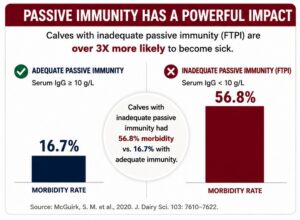
The cost of getting this wrong is widely understood but rarely talked about. A meta-analysis (Raboisson et al., 2016) found that calves with FTPI face twice the risk of mortality, 1.75 times the risk of bovine respiratory disease (BRD), and 1.5 times the risk of diarrhea. The same study estimated FPTI costs $70 USD per dairy calf and $92 USD per beef calf. Further, a Canadian study examining calves entering feedlots found that calves with inadequate transfer of passive immunity had a morbidity rate of 56.8% compared with just 16.7% among calves with adequate passive immunity. Calves with inadequate passive immunity also required approximately twice as many antibiotic treatments during the feeding period (Abdallah et al., 2022).
What does this look like in practice? For a 400-calf dairy with a 30% FTPI rate, that means 120 calves at roughly $70 to $92 USD/hd in direct costs. Before accounting for lost weight gain, delayed recovery, labour demand, increased risk of future treatments and discount at the feedlot, this is $8,400 to $11,040 USD hit for not delivering timely, quality colostrum.
The Antibiotic Problem: A Symptom Not a Strategy
Perhaps the most striking finding in the McCarthy review is this: 61–87% of non-replacement calves receive at least one antibiotic treatment during the preweaning period. In some systems, enteric morbidity approaches 85% and respiratory morbidity exceeds 80%.
These findings highlight a critical calf health challenge for the dairy-beef industry. While antibiotics remain an essential veterinary tool, focusing on morbidity prevention by improving colostrum management, nutrition, housing and transportation practices may reduce disease pressure and the need for treatment altogether.
The EU has already moved to restrict prophylactic and metaphylactic antimicrobial use under regulations EU 2019/6 and EU 2019/4. In Canada and then US, since December 2018 and June 2023 respectively, all medically important antimicrobials are prescription-only. The trajectory is clear. As regulatory and market expectations continue to evolve, producers who invest in disease prevention and antimicrobial stewardship will be best positioned to succeed.
Veterinary Recommended Solutions for Healthier Dairy-Beef Calves
The review highlights several promising strategies that reduce antimicrobial dependence without compromising animal welfare:
- Risk-based classification on arrival. Rather than treating every calf, use objective on-arrival indicators such as dehydration status, sunken flank, umbilical disease, serum total protein to identify calves at greatest risk of disease. Targeting treatment to high-risk calves can substantially reduce antibiotic use while ensuring that the animals most likely to benefit still receive intervention. Von Konigslow et al. (2025) found this approach effectively reduced antimicrobial usage in beef on dairy calves, though mortality outcomes need continued monitoring.
- Extended colostrum feeding. Providing colostrum for the first two weeks post-arrival to non-replacement calves at a rearing facility reduced diarrhea incidence in calves with low serum IgG (Wang et al., 2025). This is a practical, low-tech intervention that leverages the gut-health benefits of colostrum beyond the traditional first-day window.
- Colostrum as therapy. Carter et al. (2022) demonstrated that feeding colostrum at the onset of diarrhea hastened resolution, offering a possible alternative to antibiotic treatment for enteric disease.
- Better milk replacer formulation. Prophylactic antimicrobials in medicated milk replacers have shown inconsistent or negative impacts on calf health and gut microbiota (Berge et al., 2009; Buss et al., 2021; Cangiano et al., 2023). Replacing medicated MR with higher-quality, non-medicated formulations that include adequate fat and protein may address the underlying nutritional deficiency driving disease susceptibility.
Emerging evidence also suggests that crossbred calves may require fewer antimicrobial treatments than Holstein males (McCarthy et al., 2025), potentially because of improved passive immunity transfer at lower colostrum volumes. This is another inherent advantage of beef-on-dairy genetics that gets erased when colostrum management is inadequate.
In Conclusion
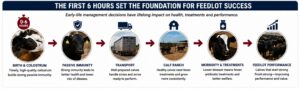
The life of a beef on dairy calf doesn’t start at the feedlot, it starts at the dairy. Modern science continues to demonstrate that colostrum management, passive immunity, nutrition and early-life calf care have lasting impacts on health, antibiotic use, welfare and feedlot performance.
As beef on dairy calves become an increasingly valuable component of North American beef production, producers have a unique opportunity to improve outcomes through evidence-based and economics-backed management. Delivering high-quality colostrum quickly and consistently remains one of the most effective investments a producer can make to improve calf health and productivity long-term.
The feedlot already recognizes the value of a health calf. The science confirms it. The economics support it. The question is no longer whether beef on dairy calves are worth the investment, it is whether producers can afford to overlook the management practices that shape their future success.
Learn more on how to optimize calves for future success with SCCL’s On-Farm Colostrum Management Guide
Sydney Fortier, M.Sc.
Marketing Communications Specialist, SCCL