


Adapted from case study: A holistic approach to colostrum management: Enrichment of maternal colostrum combined with extended colostrum feeding as control measures for bovine rotavirus-associated neonatal calf diarrhoea. Ryan C. T. Davies, Katharine Denholm
Introduction
Diarrhea consistently throws a wrench into an already busy time of the year for calf managers whether said calves are black and white spotted, red, white, blue or any other variation. Preventing diarrhea before it strikes is one way to ensure animals can perform to their potential and reduce the already abundant workload during calving. Identifying the root causes of an outbreak and adopting a holistic approach can be the key to improving future calf health, helping give calves their best start and setting them up to become productive, long-lasting members of the herd.
A recent case study investigating a diarrhea outbreak on a UK dairy operation provided key insight on how refining colostrum management can make a major impact. When a dairy farmer noticed 100% of his calves aged 8 to 21 days were showing signs of diarrhea, they worked with their veterinarians to see what the cause could be and explore management changes to prevent future outbreaks. What they discovered was that among all the new technologies and tools to control disease, sometimes going back to the basics with good hygiene, standardizing care, and proper timing is all it takes to set calves up for success.
The Case
The herd consisted of 600 Holstein cows with an autumn block calving system, housed indoors and milked twice daily. Calves were housed individually until 10 days old where they were grouped in pens of ~40 head until weaning at 7 weeks. As soon as possible after birth, calves were fed 3.5L of pasteurized (140 °F or 60 °C for 60 min) maternal colostrum (over 22% Brix), followed by a second 2L feeding of colostrum. However, delays in the first feeding were common because of limited pasteurizing capacity. After the two colostrum feedings on day one, calves were placed on a milk replacer ration.
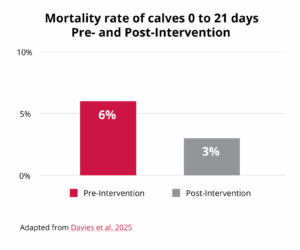
Despite high standards for hygiene, reducing exposure to unnecessary pathogens, and being fed good-quality colostrum in adequate amounts, farm management reported that every calf aged 8 to 21 days (n = 430) were experiencing diarrhea (runny or watery fecal consistency), and mortality in calves less than 21 days was 6%.
Investigation and Findings
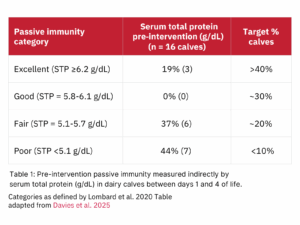
The veterinary team collected fecal samples from six diarrheic calves which all tested positive for bovine rotavirus (BRV-A) and E. coli. Blood samples were taken from 12 calves and using the new guidelines (see table below) were analyzed for serum total protein (STP) to assess transfer of passive immunity. Results showed:
‣ 43.8% had failure of transfer of passive immunity (FTPI),
‣ 37.5% had ‘fair’ passive immunity
‣ 18.8% were classified as ‘excellent’
For reference, the target benchmarks are: >40% of calves at excellent status, ~30% at good status, ~20% at fair status and <10% at poor status (see table below).
Recommended Changes
Diarrhea can be a complex disease with many causes and several contributing factors. As a result, veterinarians took a few steps back, considered their observations and test results, and implemented three changes to optimize colostrum management.
1. Feed colostrum as soon as possible after birth
Although colostrum quality was good, delays resulting from harvesting and pasteurization (taking approximately 2-3h), compounded by the limited capacity of the pasteurizer, likely reduced calves’ potential for antibody absorption. To address this, the farm began freezing excess pasteurized colostrum to have a readily available supply to newborn calves. This reduced the average time of feeding of first feeding from several hours to within 20 min after birth.
2. Standardize Colostrum Quality Through Brix Testing and Enrichment
While the average Brix (%) was 24% for cows and 22% for heifers, there was significant variation in quality (20% to 30% in cows and 12 % to 25% in heifers). Although no colostrum under 22% Brix was fed, this is a minimum recommendation, a Brix of 30% or ideally feeding at least 300g of IgG is preferred to support successful transfer of passive immunity. To achieve this, the farm began enriching their collected colostrum with a100% bovine colostrum powder (SCCL CCT 100) to standardize colostrum quality to 30% Brix (correlates to 100g/L of IgG). The amount of powder needed to reach 30% Brix was determined using the ‘Colostrum Calculator’ app.
Tip: Not all bovine colostrum powders are created equal. Choose a product that is 100% natural bovine colostrum rather than one stripped of colostral fat and supplemented with whey or vegetable fats.
3. Extended Colostrum Feeding
Previously, calves were abruptly transitioned from colostrum to milk replacer on day two, likely increasing diarrhea risk due to loss of gut-level immune protection and lack of additional nutritional benefits typically provided via transition milk. To remedy this, a 10-day extended colostrum feeding program was implemented by supplementing the milk replacer twice daily with 70g of whole bovine colostrum powder dissolved into 140 ml of water. This mimicked the benefits of transition milk by providing consistent antibody levels without the pathogen risk or supply limitations of raw transition milk.
The Results
By implementing a few small but meaningful changes in the last four weeks of calving, calf health improved dramatically compared to calves born in the first 10 weeks. 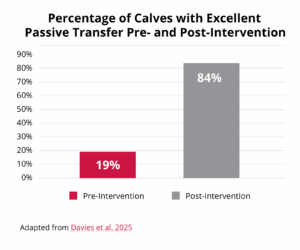
‣ Calves in the ‘excellent’ category for STP jumped from 19% (first 10 weeks) to 84% (last 4 weeks)
‣ Diarrhea incidence dropped from 100% (430 calves) to 8.6% (6/70 calves)
‣ Mortality in calves less than 21 days dropped from 6% to 3%
Key Takeaways
So what can we draw from this case to improve management for calf rearers across the board?
‣ Enriching maternal colostrum with whole bovine colostrum powder is a practical on-farm method to standardize antibody delivery to calves. This means, less variability in the quality of colostrum being delivered to individual calves and consistently more successful transfer of passive immunity.
‣ Closing the window between when a calf is born and when the first colostrum is fed is essential.
‣ Employing methods like keeping a stock of frozen pre-pasteurized, good quality colostrum to be thawed when needed maximizes the potential for that calf to absorb essential antibodies.
‣ Supplementing whole bovine colostrum powder into a milk ration mimics the benefits of feeding transition milk without having to be concerned with limited supply or risking exposing young calves to pathogens.
While there is no one-size-fits-all approach, taking a look at your operation with your veterinarian and identifying opportunities to strengthen colostrum management can be the key to better calf health, giving the next generation of your herd their best start to grow healthy and stay productive.