


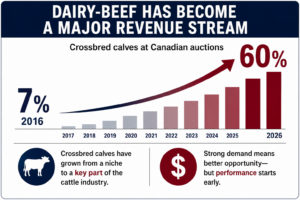
 La industria de la carne de res en el sector lechero ha experimentado una transformación notable durante la última década. A medida que ha aumentado el valor de los terneros, la producción de carne de res lechera ha pasado de ser un subproducto de la producción lechera a convertirse en una importante fuente de ingresos para muchas granjas lecheras. La adopción generalizada del semen sexado, junto con la disminución del rebaño de vacas de carne en América del Norte, ha creado esta oportunidad para los productores lecheros. En Canadá, los ternos de cruza representaron el 60 % de las ventas en el mercado de subastas en 2025, en comparación con solo el 71 % en 2016. Además, las ventas de semen de carne a las granjas lecheras de EE. UU. han crecido un 26 % en los últimos cinco años. Al mismo tiempo, los corrales de engorde se apresuran a llenar sus corrales, ya que el rebaño de vacas de carne ha caído a su nivel más bajo desde principios de la década de 1960. Como resultado, los terneros que antes se consideraban difíciles de comercializar ahora alcanzan habitualmente precios superiores a $1400 USD.
Sin embargo, un mayor valor conlleva un mayor escrutinio. Los criadores de terneros y los responsables de los corrales de engorde saben desde hace tiempo que el manejo durante las primeras etapas de vida en la granja lechera influye en la salud y el rendimiento posteriores. A revisión exhaustiva reciente Un artículo publicado en el Journal of Dairy Science pone de relieve la magnitud de este desafío. El uso de antimicrobianos en terneros lecheros-de-carne antes del destete sigue siendo extremadamente elevado, con tasas de morbilidad entérica que se acercan al 85% y de morbilidad respiratoria que superan el 80% en algunos sistemas. Además, entre el 61% y el 87% de los terneros no destinados a la reposición reciben al menos un tratamiento antimicrobiano durante el período previo al destete. Esto confirma que la forma en que se crían estos terneros de carne y leche antes de llegar a los ranchos y corrales de engorde es fundamental. La noticia alentadora es que unos simples ajustes en el manejo ofrecen una gran oportunidad para mejorar la salud, el bienestar y el rendimiento a largo plazo de los terneros.
Una nueva investigación en ciencia lechera confirma la importancia de la salud de los terneros en las primeras etapas de vida
McCarthy et al. (2026) y su equipo de la Universidad de Guelph Elaboraron un estudio centrado específicamente en el manejo previo al corral de engorde de los terneros de carne procedentes de lecherías. Abordaron todo el ciclo de vida, desde la genética hasta el calostro, pasando por el transporte, el uso de antimicrobianos, la nutrición, el destete y los efectos de los diferentes métodos de manejo en la salud en el corral de engorde. Su conclusión fue clara: para que la producción de terneros de carne procedentes de lecherías sea sostenible, es necesario abordar los retos relacionados con la salud y el bienestar durante el período previo al corral de engorde. Actualmente, estos animales están quedando desatendidos en comparación con las terneras lecheras y los terneros de carne de raza pura.
Este análisis estableció una clara relación entre el manejo de los terneros en las primeras horas de vida y cómo esto repercute en todas las etapas posteriores de la producción. La falta de administración oportuna del calostro se traduce en la necesidad de un tratamiento con antibióticos para la neumonía a las tres semanas de edad. El programa de sustituto de leche con bajo volumen se traduce en que el ternero pierda entre 3 y 181 TP3T de su peso corporal durante el transporte y tarde semanas en recuperar el consumo de alimento. El ternero que fue vacunado de manera inadecuada, mal preparado para el transporte o enviado a una edad temprana se presenta en el corral de engorde como un animal de menor valor debido a su bajo rendimiento o a las altas tasas de tratamiento y morbilidad. Las decisiones de manejo tomadas durante las primeras semanas de vida influyen en muchos de los resultados futuros de salud y rendimiento del ternero, mucho antes de que siquiera salga de la granja lechera.
Gestión del calostro: la base de la salud de los terneros lecheros y de carne
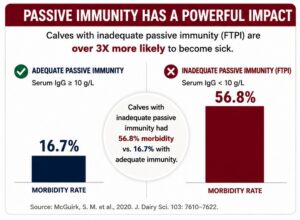 El informe McCarthy pone de manifiesto lo que muchos en el sector llevan años observando: los terneros no destinados a la cría, a pesar de los precios récord, suelen sufrir diferentes prácticas de manejo del calostro que las novillas de reposición de la misma granja. A estos terneros se les inicia la alimentación más tarde y se les administra calostro con mayor contaminación bacteriana y una concentración insuficiente de IgG, lo que limita sus posibilidades de lograr una transferencia satisfactoria de la inmunidad pasiva. Esto probablemente explique por qué hasta el 43% de los terneros que llegan a las granjas de engorde presentan un fallo en la transferencia de la inmunidad pasiva (FPTI).
El costo de un mal manejo en este aspecto es ampliamente conocido, pero rara vez se menciona. Un metaanálisis (Raboisson et al., 2016) reveló que los terneros con FTPI tienen el doble de riesgo de mortalidad, 1,75 veces más riesgo de padecer enfermedad respiratoria bovina (BRD) y 1,5 veces más riesgo de sufrir diarrea. El mismo estudio estimó que la FPTI cuesta entre 1 y 470 USD por ternero lechero y entre 1 y 92 USD por ternero de carne. Además, un estudio canadiense que examinó a los terneros que ingresaban a los corrales de engorde encontró que los terneros con una transferencia inadecuada de inmunidad pasiva tenían una tasa de morbilidad de 56,81 %, en comparación con solo el 16,71 % entre los terneros con inmunidad pasiva adecuada. Los terneros con inmunidad pasiva inadecuada también requirieron aproximadamente el doble de tratamientos con antibióticos durante el período de engorde (Abdallah et al., 2022).
¿Cómo se traduce esto en la práctica? Para una granja lechera de 400 terneros con un índice FTPI de 30%, eso significa 120 terneros con unos costos directos de entre $70 y $92 USD por cabeza. Sin contar la pérdida de aumento de peso, la recuperación tardía, la demanda de mano de obra, el mayor riesgo de tratamientos futuros y el descuento en el corral de engorde, esto representa un impacto de entre $8,400 y $11,040 USD por no suministrar calostro de calidad a tiempo.
El problema de los antibióticos: un síntoma, no una estrategia
Quizás el hallazgo más llamativo del estudio de McCarthy sea el siguiente: entre el 61 % y el 87 % de los terneros no destinados a la reposición reciben al menos un tratamiento con antibióticos durante el período previo al destete. En algunos sistemas, la morbilidad entérica se acerca al 85 % y la morbilidad respiratoria supera el 80 %.
Estos hallazgos ponen de relieve un problema crítico para la salud de los terneros en el sector de la ganadería lechera y de carne. Si bien los antibióticos siguen siendo una herramienta veterinaria esencial, centrarse en la prevención de la morbilidad mediante la mejora de las prácticas de manejo del calostro, la nutrición, el alojamiento y el transporte podría reducir la incidencia de enfermedades y, en última instancia, la necesidad de tratamiento.
La UE ya ha tomado medidas para restringir el uso profiláctico y metafiláctico de antimicrobianos en virtud de los Reglamentos (UE) 2019/6 y (UE) 2019/4. En Canadá y luego en EE. UU., desde diciembre de 2018 y junio de 2023 respectivamente, todos los antimicrobianos de importancia médica son de venta exclusiva con receta médica. La trayectoria es clara. A medida que las expectativas regulatorias y del mercado continúan evolucionando, los productores que inviertan en la prevención de enfermedades y la gestión responsable de los antimicrobianos estarán en la mejor posición para tener éxito.
Soluciones recomendadas por veterinarios para terneros lecheros-de carne más sanos
El estudio destaca varias estrategias prometedoras que reducen la dependencia de los antimicrobianos sin comprometer el bienestar animal:
- Clasificación basada en el riesgo a la llegada. En lugar de tratar a todos los terneros, utilice indicadores objetivos a la llegada, como el grado de deshidratación, el flanco hundido, las afecciones umbilicales o la proteína sérica total, para identificar a los terneros con mayor riesgo de enfermedad. Centrar el tratamiento en los terneros de alto riesgo puede reducir considerablemente el uso de antibióticos, al tiempo que se garantiza que los animales con mayores probabilidades de beneficiarse sigan recibiendo la intervención. Von Konigslow et al. (2025) descubrieron que este enfoque reducía eficazmente el uso de antimicrobianos en terneros de carne y lecheros, aunque es necesario un seguimiento continuo de los resultados de mortalidad.
- Alimentación prolongada con calostro. La administración de calostro durante las dos primeras semanas tras la llegada a las instalaciones de cría a los terneros no destinados a la reposición redujo la incidencia de diarrea en los terneros con niveles bajos de IgG sérica (Wang et al., 2025). Se trata de una intervención práctica y de baja complejidad que aprovecha los beneficios del calostro para la salud intestinal más allá del tradicional periodo del primer día.
- El calostro como tratamiento. Carter et al. (2022) demostraron que la administración de calostro al inicio de la diarrea aceleraba la recuperación, lo que ofrece una posible alternativa al tratamiento con antibióticos para las enfermedades entéricas.
- Una mejor formulación del sustituto de leche. Los antimicrobianos profilácticos presentes en los sustitutos de leche medicados han demostrado tener efectos inconsistentes o negativos sobre la salud de los terneros y la microbiota intestinal (Berge et al., 2009; Buss et al., 2021; Cangiano et al., 2023). La sustitución de los sustitutos de leche medicados por formulaciones no medicadas de mayor calidad, que incluyan los niveles adecuados de grasa y proteína, podría resolver la deficiencia nutricional subyacente que aumenta la susceptibilidad a las enfermedades.
Las pruebas más recientes también sugieren que los terneros de cruces pueden necesitar menos tratamientos antimicrobianos que los machos de raza Holstein (McCarthy et al., 2025), posiblemente debido a una mejor transferencia de inmunidad pasiva con volúmenes más bajos de calostro. Esta es otra ventaja inherente de la genética de cruces entre razas de carne y lecheras que se pierde cuando la gestión del calostro es inadecuada.
En conclusión
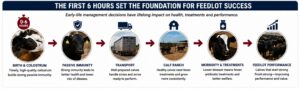
La vida de un ternero de carne criado en una granja lechera no empieza en el corral de engorde, sino en la granja lechera. La ciencia moderna sigue demostrando que la gestión del calostro, la inmunidad pasiva, la nutrición y los cuidados prestados al ternero durante sus primeras etapas de vida tienen un impacto duradero en su salud, el uso de antibióticos, su bienestar y su rendimiento en el corral de engorde.
A medida que la carne de ternos lecheros se convierte en un componente cada vez más valioso de la producción de carne de res en América del Norte, los productores tienen una oportunidad única de mejorar los resultados mediante una gestión basada en la evidencia y respaldada por criterios económicos. Proporcionar calostro de alta calidad de manera rápida y constante sigue siendo una de las inversiones más efectivas que un productor puede realizar para mejorar la salud y la productividad de los ternos a largo plazo.
Los criaderos ya reconocen el valor de un ternero sano. La ciencia lo confirma. Los datos económicos lo respaldan. La cuestión ya no es si la carne de terneros lecheros merece la inversión, sino si los productores pueden permitirse pasar por alto las prácticas de manejo que determinan su éxito futuro.
Descubre cómo optimizar el rendimiento de los terneros para garantizar el éxito futuro con SCCL’s Guía para el manejo del calostro en la granja
Sydney Fortier, M.Sc.
Especialista en comunicaciones de marketing, SCCL