


We all dream to win the lottery, and I can proudly say I have.. unfortunately only a measly $4.00 of winnings. Not exactly the “jackpot”, it didn’t benefit my finances in any impactful way. We can think of calf colostrum management as the lottery as well. Are all your calves receiving colostrum? Is it excellent and maximally impactful? Like my lottery winnings, just receiving any colostrum does not mean a calf has received impactful nutrients and immunity. Luckily, unlike playing the lottery, we have control over the quantity, quality and impact of our colostrum management.
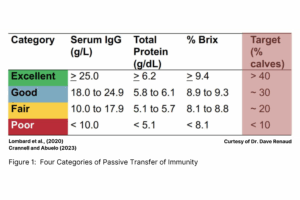
Calves are born with no antibodies (the basis of what makes up an immune system) as they do not pass to the calf through the bovine placenta like they would in other animals. The only opportunity to receive immunity is through colostrum and passive transfer of antibodies from the gut to the bloodstream. For decades, this transfer of immunity was viewed as either pass or fail. The failure of passive transfer meant a higher risk of illness or death, and it still does, but we now understand there is more nuance. In 2020, new guidelines regarding newborn calf immunity were published¹ describing four categories of passive transfer of immunity; excellent, good, fair, and poor representing > 25.0, 18.0 to 24.9, 10.0 to 17.9 and <10.0 g/L of serum IgG (Figure 1). We now know that with improving levels of immunity transferred, the risk of illness is reduced. All calves are valuable, so ensuring all receive excellent levels of immunity to remain healthy should be a priority.
Maximizing the use of maternal colostrum from the dams in your herd should be the first step in ensuring excellent immunity transfer to calves. It is an already available and valuable resource and provides antibodies specific to the environment calves are being introduced into. However, colostrum quality can be variable, meaning not all of it will be effective at providing excellent passive transfer (Figure 2). Quality can vary with time from birth to collection, lactation number, and nutrition, among other factors. Colostrum quality is deemed to be excellent at 25% Brix or more. The variability and clear margins for what constitutes excellent quality demonstrates the importance of testing each collection of colostrum using a brix meter (on-farm tool) or utilizing radial immunodiffusion (RID) testing (laboratory test). Colostrum not passing the test? Not to worry, as maternal colostrum can be enriched with dried whole bovine colostrum as a simple method to ensure every calf receives an excellent level of immunity and limit the amount of valuable maternal colostrum that needs to be dumped.

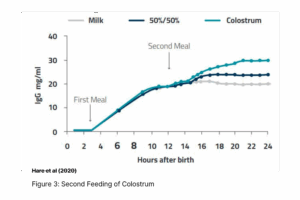
In addition to the crucial first feeding, a second feeding of excellent quality colostrum within the first 12 hours of life significantly improves the antibody levels in a calf’s bloodstream.² As shown in Figure 3, enrichment of maternal colostrum can extend volume and ensure quality remains excellent to allow for a second feeding.
The benefits of enrichment don’t end there. Enrichment using whole bovine dried colostrum broadens the antibody spectrum of maternal colostrum. Any single collection’s antibody profile depends on the individual dam’s exposure and vaccinations status to specific pathogens her ability to channel those antibodies into colostrum, and time for colostrum production prior to calving.
Maternal colostrum and SCCL’s whole bovine dried colostrum contain a high proportion of IgG1 and smaller amount of IgG2. IgG1 concentration is important, as it is re-secreted on mucosal surfaces to protect the calf from diarrhea and pneumonia, IgG2s do not (consider this when purchasing a colostrum replacer). Plasma-based products have nearly equal proportions IgG1: IgG2, reducing its protective capability.³ designation specifically ensures consistent quality, known cleanliness, and effective antibodies to a wide range of pathogens. SCCL’s USDA and CFIA Veterinary Biologic designation specifically ensures consistent quality, known cleanliness, and effective antibodies to a wide range of pathogens.
The fat in maternal colostrum (colostral fat) has been shown to ignite calves’ brown fat metabolism which is vital to thermoregulation. Calves receiving colostrum replacers that are not whole, are deficient in colostral fat as fat is replaced with alternative, usually plant derived, sources. This has been shown to reduce growth and increase the risk of respiratory disease.
Feeding excellent quality, clean colostrum, whether maternal, whole dried, or a combination of the two is essential for calf immunity, capacity to thermoregulate, and true epigenetic programming. Avoid formulas of proteins and fats from other sources, as products assembled from serums and oils cannot match the benefits of whole colostrum. SCCL’s whole bovine colostrum products contain all the immune, metabolic and growth factors naturally found in maternal colostrum and are ideal for enriching to give every calf their very best start with excellent quality colostrum.
–
Citations
- Lombard, J. et al., Consensus recommendations on calf- and herd-level passive immunity in dairy calves in the UnitedStates. Journal of Dairy Science, Volume 103, Issue 8, 7611 – 7624
- Hare, K. S., et al. Feeding colostrum or a 1:1 colostrum:whole milk mixture for 3 days after birth increases serumimmunoglobulin G and apparent immunoglobulin G persistency in Holstein bulls. Journal of Dairy Science, Volume 103,Issue 12, 2020, Pages 11833-11843
- Godden, S.M., Haines, D.M., Hagman, D. Improving passive transfer of immunoglobulins in calves. I: Dose effect offeeding a commercial colostrum replacer, Journal of Dairy Science, Volume 92, Issue 4, 2009, Pages 1750-1757